
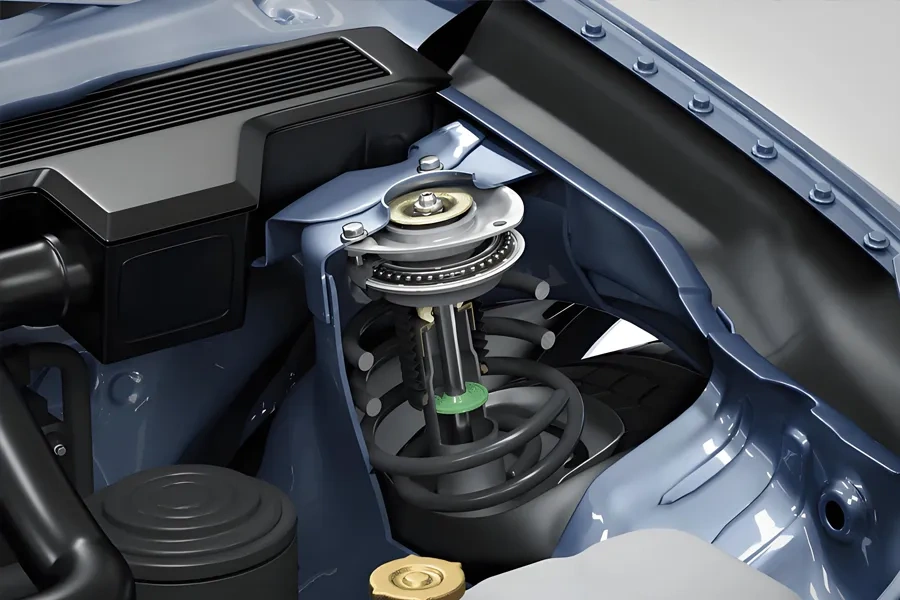
The main fault diagnosis techniques for ball bearings include vibration diagnosis, ferrography, temperature diagnosis, acoustic diagnosis, oil film resistance diagnosis and fibre-optic monitoring. Of these, vibration, ferrography and temperature diagnosis are the most widely used.
1. Vibration Diagnosis Technology When fatigue spalling, indentations or localised corrosion occur on the working surfaces of bearing components, periodic pulsating signals will be generated during the operation of ball bearings. These periodic signals can be captured by sensors (velocity-type or acceleration-type) mounted on the bearing housing, and bearing faults can be diagnosed by analysing the vibration signals.
Characteristics: Vibration diagnosis technology is widely applied; it enables online monitoring; diagnosis is rapid, and the diagnostic theory is well-established. Scope of application: Particularly suitable for fault monitoring of bearings in rotating machinery. 2. Ferrography Diagnosis Technology Bearing wear particles are closely linked to the operating conditions of the bearing. When lubricating oil containing wear particles is passed through a strong magnetic field, the particles settle on a ferrografic plate in a specific pattern under the influence of the magnetic field. The ferrografic plate can be examined qualitatively under a ferrografic microscope or tested on quantitative instruments to assess the bearing’s operating condition.
Features: No need to dismantle the machine; low investment with good results; capable of detecting early fatigue failure in bearings; suitable for research into wear mechanisms.
Scope of application: Suitable for fault diagnosis of bearings lubricated with oil; less suitable for grease-lubricated bearings.
3. Oil film resistance diagnosis technology
In well-lubricated bearings, the oil film creates significant electrical resistance between the inner and outer rings. Therefore, by measuring the resistance between the inner and outer rings, abnormalities in the bearing can be identified.
Features: A single evaluation criterion can be applied across different operating conditions. However, it is less effective for diagnosing abnormalities such as surface spalling, indentations and cracks. Scope of application: Suitable for applications where the rotating shaft is exposed.
4. Fibre-optic Monitoring and Diagnostic Technology
Fibre-optic monitoring is a diagnostic technique that directly extracts signals from the surface of the bearing rings. A displacement sensor made from a bundle of optical fibres comprises a transmitter fibre bundle and a receiver fibre bundle. Light from the transmitter fibre bundle is reflected back through the gap between the sensor end face and the bearing ring surface, received by the receiver fibre bundle, and converted into an electrical signal by a photodetector. By analysing and processing this electrical signal, the operating condition of the bearing can be assessed.
Features: Fibre-optic displacement sensors offer high sensitivity; signals are extracted directly from the bearing surface, improving the signal-to-noise ratio; they can directly reflect the manufacturing quality, surface wear, load, lubrication and clearance conditions of ball bearings.
Scope of application: Suitable for machinery where the sensor can be installed within the bearing housing.
5. Temperature Diagnostic Technology
If a bearing develops an abnormality, its temperature will change. Consequently, ball bearing faults can be diagnosed based on temperature changes, although the ability to identify specific anomalies is limited.
Features: Simple diagnosis; effective for detecting bearing scorching. Scope of application: Suitable for simple, routine diagnosis of bearings in machinery.
6. Acoustic Emission Diagnostic Technology
In metallic materials, the occurrence of dislocations within the internal crystal lattice, slip at grain boundaries, or the formation and propagation of internal cracks all require the release of elastic waves; this phenomenon is known as acoustic emission. When spalling or cracks occur in ball bearings, different types of acoustic emission signals are generated, which can be used to assess the bearing’s operating condition.
Features: Rapid and straightforward diagnosis; suitable for online monitoring. Scope of application: A new technology developed in recent years, it is currently used infrequently in bearing condition monitoring.
You can select product type online samples, product samples, installation manuals, and OID Product related applications here.
You can find here that in addition to various bearings, we also provide various products such as automotive parts and precision machinery products to the world.