
Rolling bearings are precision components and must be handled with great care. Even high-quality bearings will not perform as expected if used incorrectly. The precautions for using bearings are as follows.
1. Keep the bearings and their surroundings clean
Even minute particles of dust invisible to the naked eye can adversely affect bearings. Therefore, keep the surrounding area clean to prevent dust from entering the bearings.
2. Handle with care
Subjecting bearings to severe impact during use can cause scratches or indentations, which may lead to accidents. In severe cases, this can result in cracks or fractures, so great care must be taken.
3. Use specialised bearing tools
Specialised tools must be used; do not substitute them with other items.
4. Prevent rusting of bearings
Hand perspiration can cause rust when handling bearings. Ensure hands are clean, wear gloves where possible, and be mindful of corrosive gases.
The correct installation of bearings has a direct impact on their precision, service life and performance during operation. Therefore, the design and assembly departments must thoroughly investigate bearing installation and carry it out in accordance with operational standards.
一、 Preparations before installation
1. Clean the bearings and related components
2. Check the dimensions and precision of the relevant components
3. Confirm the installation direction and fit type
4. Prepare the specialised installation tools
It is recommended that the bearing packaging is only opened immediately prior to installation. Generally, for grease-lubricated bearings, cleaning is not required; grease should be applied directly. For oil-lubricated bearings, cleaning is also generally unnecessary. However, for bearings used in precision instruments or high-speed applications, they must be cleaned with a clean solvent to remove the rust inhibitor applied to the bearing. Bearings from which the rust inhibitor has been removed are susceptible to rust and must not be left exposed.
Bearings that have been pre-filled with grease should be used without cleaning.
二、Bearing Installation Methods
Bearing installation methods vary depending on the bearing’s structure, fit and operating conditions. As the shaft typically rotates, the inner ring usually requires an interference fit.
Cylindrical bore bearings: These are usually pressed in using a press or installed using a hot-fitting method.
Tapered bore bearings: These are either fixed directly onto a tapered shaft or installed using a locking collar or removal sleeve.
When mounting into a bearing housing, a clearance fit is usually employed. Where the outer ring has an interference fit, it is typically pressed in using a press or installed after cooling. When using dry ice for cooling during installation, moisture in the air may condense on the bearing surface; therefore, anti-rust measures must be taken.
三、Installation of Cylindrical Bore Bearings
1. Press-fitting method
Press-fitting is widely used for small bearings. During installation, a shim must be placed against the inner ring to press it slowly into position until it abuts the shaft shoulder. It is prohibited to press the inner ring in via the outer ring to avoid indentations or damage to the raceways.
Oil should be applied to the mating surfaces during operation. When striking with a hammer, a soft shim must be used to prevent damage to the bearing.
For non-separable bearings (such as deep groove ball bearings) where both the inner and outer rings have an interference fit, specialised shims must be used to press both rings in simultaneously.
For separable bearings (such as cylindrical roller bearings and tapered roller bearings), the inner and outer rings may be installed separately; when assembling, ensure there is no misalignment to prevent scratching of the rolling surfaces.
2. Hot-fitting Method
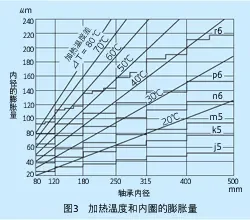
Large bearings exert significant pressing forces and are difficult to install directly; therefore, the hot-fitting method is widely used: the bearing is heated in oil to cause it to expand, and then fitted onto the shaft.
Hot-fitting prevents improper installation forces and reduces the time required for the operation.
Precautions for hot mounting:
(a) The bearing heating temperature must not exceed 120°C.
(b) The bearing must not come into direct contact with the bottom of the oil bath; it should be placed on a metal mesh rack.
(c) The heating temperature should be 20–30°C higher than the required temperature to prevent installation difficulties after cooling.
(d) After cooling during installation, the bearing width will contract; the locking nut must be tightened to prevent a gap forming between the inner ring and the shaft shoulder.
四、 Induction Heating Equipment
In addition to oil bath heating, induction heating equipment is also widely used for the hot mounting of bearings.
Induction heating equipment utilises the principle of electromagnetic induction to cause the bearing itself to heat up rapidly and uniformly. It requires no oil or open flame, making the process clean, efficient and safe.
They are suitable for bearings that are frequently mounted and dismounted, such as those in rolling mills, railway rolling stock, electric motors and gearboxes.
五、Installation of Tapered Bore Bearings
Tapered bore bearings can be mounted directly onto tapered shafts, or onto cylindrical shafts using adapter sleeves or removal sleeves.
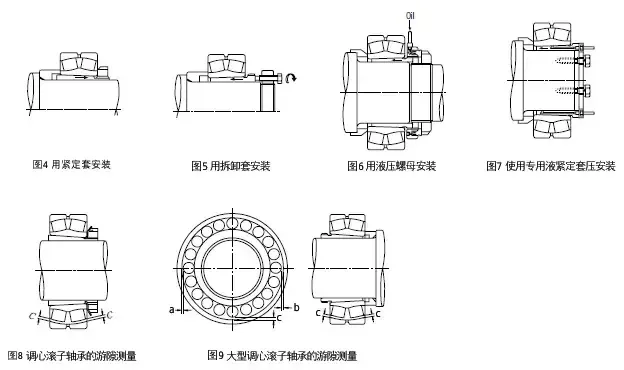
Large self-aligning roller bearings are typically installed using hydraulic pressure, employing hydraulic nuts or high-pressure oil to facilitate easy installation and prevent damage to the bearings.
When installing self-aligning bearings, adjustments must be made according to the reduction in radial clearance. When measuring clearance, the deformation zone at the bottom of the bearing should be avoided; the average horizontal clearance should be used as the standard to ensure installation accuracy.
Once the self-aligning bearing has been installed, it is essential to ensure that the outer ring can rotate freely to guarantee stable operation.
Once bearing installation is complete, a trial run must be carried out to ensure correct installation and stable operation. This inspection allows for the early detection of abnormalities, thereby preventing faults during equipment operation and extending the service life of the bearings.
一、Trial Run
After bearing installation is complete, it is recommended to first conduct a no-load trial run; only proceed to loaded operation once no abnormalities have been detected.
During the trial run, pay close attention to the bearing’s rotational state, vibration, noise and temperature changes to ensure smooth operation without unusual sounds.
If the trial run proceeds satisfactorily, the rotational speed and load may be gradually increased to enter the normal operating phase.
二. In-Service Inspection 1. Rotational Noise Inspection
A bearing operating normally should emit a uniform, faint running sound, free from extraneous noises, impact sounds or abnormal whistling. The presence of periodic abnormal noises or metallic grinding indicates an issue with the bearing or its installation.
2. Vibration Inspection
During operation, the bearing should maintain stable vibration without noticeable jumping or wobbling. Excessive vibration accelerates bearing fatigue, wear and damage to the cage, and the cause must be investigated promptly.
Abnormal vibration is typically caused by installation eccentricity, shaft deflection, improper fit or insufficient lubrication.
3. Temperature Inspection
Bearing temperature is a key indicator of operational condition. Generally, bearing operating temperature should remain within a reasonable range; a sudden rise in temperature or persistently high temperatures are considered abnormal.
Common causes of abnormal temperatures include: excessive or insufficient lubrication, excessive interference fit, installation misalignment, excessive load, or poor ambient heat dissipation.
三. Lubrication Condition Inspection
Lubrication is key to ensuring stable bearing operation. During operation, it is necessary to verify that the grease or lubricating oil is sufficient, clean, free from leakage and has not deteriorated.
If the lubricant is contaminated, has clumped, carbonised or is leaking, it must be replaced or replenished promptly, and the seals must be checked for integrity.
四. Seal Condition Inspection
The function of bearing seals is to prevent the ingress of dust, moisture and impurities, whilst also preventing lubricant leakage.
During operation, check the seals for wear, deformation, ageing or looseness to ensure effective sealing and prevent foreign matter from entering the bearing, which could cause wear or corrosion.
五. Shutdown Inspection
During routine maintenance of the equipment, the machine may be shut down to carry out a thorough inspection of the bearings:
1. Inspect the inner and outer rings, rolling elements and cage of the bearings for defects such as wear, spalling, cracks or rust.
2. Measure the radial and axial clearances of the bearings to determine whether they exceed the permissible limits.
3. Check whether the mating surfaces are loose and whether the shaft and bearing housing are deformed.
4. Verify the cleanliness of the lubricant and replace it completely if necessary.
六. Troubleshooting
If excessive bearing temperature, abnormal vibration or unusual noise are detected during operation, the machine must be shut down immediately for inspection; operation may only resume once the fault has been rectified.
Common causes of faults include: improper installation, inadequate lubrication, excessive load, ingress of foreign matter and reduced bearing precision.
Prompt resolution of abnormalities can effectively prevent bearing damage and ensure the long-term stable operation of the equipment.
Bearings should be disassembled at regular intervals. When carrying out maintenance or replacing components, the correct tools and methods must be used to prevent damage to the bearings, shafts, bearing housings and other parts. Disassembly operations must follow standard procedures to ensure safety and the ability to reuse components.
一、Preparations before disassembly
1. Clean dust and grease from the bearings and surrounding areas, and keep the work environment clean.
2. Prepare specialised disassembly tools, such as bearing pullers, hydraulic tools and disassembly sleeves.
3. Confirm the bearing type, fit type and direction of removal.
4. Mark important components to ensure they are reinstalled in their original positions.
二、Inner Ring Removal Methods
1. Pull-off Tool Method
For small and medium-sized bearings, a mechanical pull-off tool is typically used. Securely engage the jaws on the end face of the inner ring, rotate the screw evenly and pull the inner ring out smoothly. Under no circumstances should the outer ring be struck directly during removal, to avoid damaging the bearing.
2. Hydraulic Removal Method
For large bearings or those with significant interference fits, it is recommended to use a hydraulic puller or hydraulic removal tool. The hydraulic system provides a smooth pulling force, preventing uneven stress on the bearing and protecting both the shaft and the bearing from damage.
3. Thermal Removal Method
For bearings with significant interference fits that are difficult to remove, thermal removal may be employed. An induction heater is used to heat the inner ring uniformly and rapidly, causing it to expand and allowing for easy removal. This method is both efficient and safe.
三、Outer Ring Removal Methods
Outer rings may be removed using specialised outer ring pullers or sleeve ejection methods. During removal, ensure that the force is applied evenly to the outer ring to prevent damage to the bearing housing bore caused by uneven loading.
For tightly fitted outer rings, the cooling contraction method or specialised tools for ejection may be used to ensure a smooth and damage-free removal process.
四、Dismantling Tapered Bore Bearings
Specialised tools are required for the removal of tapered bore bearings, locking sleeves and removal sleeves. After loosening the locking nut, use an installation tool to withdraw the bearing smoothly, avoiding forceful hammering which may damage the tapered surface.
Large self-aligning roller bearings may be removed using hydraulic methods, which are easy to operate and highly efficient, effectively protecting the bearing and shaft mating surfaces.
五、 Precautions for Dismantling
1. Do not apply impact forces to the bearing cage or rolling elements during disassembly.
2. Do not use a flame to heat the bearing directly, as this may alter the properties of the bearing material.
3. Disassembled bearings should be inspected, cleaned and treated with rust protection without delay.
4. Bearings that cannot be reused should be disposed of safely to prevent misuse.
5. After removal, inspect the precision and wear of the shaft and bearing housing to provide a basis for reinstallation.
六、 Removal Tool Support
Specialised removal tools and induction heating equipment are provided, suitable for the rapid and safe removal of all types of bearings. These tools effectively minimise component damage and enhance maintenance efficiency, making them suitable for the maintenance of various industrial equipment such as motors, gearboxes, rolling mills and conveying equipment.
To extend the service life of bearings and ensure stable operation, regular maintenance and inspections must be carried out to identify potential issues in good time and prevent faults from occurring.
一、Lubrication Maintenance
1. Top up or replace grease and lubricating oil at regular intervals.
2. Ensure that the lubricant is clean, free from impurities and moisture.
3. Select appropriate lubricants based on rotational speed, temperature and load.
二、Seal Maintenance
Regularly inspect the condition of seals and replace any that are aged, worn or damaged to prevent dust and moisture from entering the bearing interior.
三、Regular Inspections
1. Monitor operating temperature, vibration and noise levels.
2. Check for looseness, leaks and abnormal heat generation.
3. Record operating data and establish equipment maintenance records
四、OID Maintenance Service Support
OID provides professional bearing maintenance, diagnostic and repair services, offering comprehensive solutions to extend the service life of motors, gearboxes, metallurgical equipment, conveying equipment and other machinery, thereby reducing the risk of downtime and enhancing equipment reliability.
To extend the service life of bearings and reduce equipment failure rates, regular maintenance and inspections should be carried out in accordance with the operating conditions of the equipment, so that any abnormalities can be detected and rectified promptly, thereby keeping the bearings in good working order.
一、Lubrication Management
Lubrication is the most important factor affecting bearing life. Selecting the correct lubricant and replenishing or replacing it on schedule are key aspects of maintenance.
1. Select the appropriate grease or lubricating oil according to the operating conditions.
2. Regularly inspect the condition of the lubricant to prevent shortages, contamination, ageing or hardening.
3. Avoid mixing different types of lubricants.
4. Ensure the lubrication points are clean and prevent dust or moisture from entering during refilling.
二、Seal Inspection
The integrity of the seals is essential for maintaining proper bearing lubrication and preventing the ingress of foreign matter.
1. Regularly inspect seals for wear, damage, ageing or looseness.
2. Replace seals promptly if defects are found to prevent dust, moisture or metal shavings from entering the bearing interior.
3. Ensure there are no lubricant leaks.
三、Operational Condition Inspection
Regular monitoring of bearing operating conditions enables the early detection of potential faults.
1. Check for any abnormal rise in operating temperature.
2. Check for any abnormal changes in vibration or noise.
3. Ensure rotation is smooth, with no sticking or impact.
四、Periodic Maintenance
During equipment shutdown for maintenance, carry out a systematic inspection of the bearings to ensure long-term stable operation.
1. Inspect the bearings for wear, indentations, spalling, cracks or corrosion.
2. Measure the bearing clearance to ensure it is within the permissible range.
3. Check whether the fit between the shaft and bearing housing is loose or deformed.
4. After thorough cleaning, re-lubricate correctly and reinstall.
五、Handling Abnormalities
Should abnormal temperatures, vibrations or noise be detected, immediately shut down the equipment for inspection. Verify that lubrication, installation, load and fit are normal. Prompt action can prevent severe bearing damage and minimise losses due to equipment downtime.
六、 OID Maintenance Services
Oid provide professional bearing maintenance, inspection, diagnosis and repair services to help customers optimise lubrication schemes, extend bearing life and reduce maintenance costs, offering stable and reliable long-term protection for all types of equipment.