

The assembly of rolling bearings should be determined by the bearing’s structure, dimensions and the nature of the fit between the bearing components. Common methods for assembling rolling bearings include hammering, pressing, hot mounting and cold shrinking.
1. Preparatory work prior to rolling bearing assembly
(1) Prepare the necessary tools and measuring instruments for the bearing to be fitted. Check the mating parts against the drawing specifications for defects, rust and burrs.
(2) Clean the parts mating with the bearing using petrol or kerosene, wipe them dry with a clean cloth or blow-dry with compressed air, then apply a thin coat of oil.
(3) Verify that the bearing model matches the drawing specifications.
(4) Bearings preserved with anti-rust oil may be cleaned with petrol or kerosene; those preserved with heavy oil or anti-rust grease may be cleaned by heating to dissolve the grease using light mineral oil, then cooled and cleaned with petrol or kerosene before being wiped clean and set aside for use; bearings fitted with dust caps or seals on both ends, or coated with dual-purpose anti-rust and lubricating grease, do not require cleaning.
2. Assembly Methods for Rolling Bearings
(1) Assembly of Bearings for Cylindrical Bores
① For non-separable bearings (such as deep groove ball bearings, self-aligning ball bearings, self-aligning roller bearings, angular contact bearings, etc.), the assembly sequence should be determined by the tightness of the fit between the bearing rings and the housing. When the inner ring has a tight fit with the shaft journal and the outer ring has a loose fit with the housing, first mount the bearing onto the shaft, then insert it into the housing together with the shaft. Where the bearing outer ring has a tight fit with the housing bore and the inner ring has a relatively loose fit with the shaft journal, the bearing should first be pressed into the housing; where both the inner ring and the shaft, and the outer ring and the housing bore have tight fits, the bearing should be pressed onto the shaft and into the housing bore simultaneously.
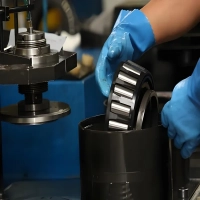
② As the inner and outer rings of separable bearings (such as tapered roller bearings, cylindrical roller bearings, needle roller bearings, etc.), the inner and outer rings can be separated freely; during assembly, the inner ring and rolling elements are fitted onto the shaft, and the outer ring is fitted into the housing, after which the clearance between them is adjusted.
Common methods for bearing assembly include the hammering method and the pressing method. For pressing, a special sleeve is used, and a copper rod is employed to tap the bearing inner ring (or outer ring) end face symmetrically and evenly. The pressing method involves pressing the bearing inner and outer rings into the journal and housing bore respectively.
If the shaft journal is large and the interference fit is significant, the hot-fitting method may be used for ease of assembly. This involves heating the bearing in oil at a temperature of 80–100 °C and then fitting it onto the shaft at room temperature. When heating the bearing, it should be placed on a wire mesh within the oil bath to prevent it from coming into contact with the bottom of the tank, which is much hotter than the oil, and to avoid contact with any sediment or contaminants at the bottom. For small bearings, they may be suspended from a hook and immersed in oil for heating. Bearings filled with grease and fitted with dust caps or seals must not be assembled using the hot-fitting method.
(2) When the interference fit of a tapered bore bearing is small, it may be fitted directly onto a tapered journal, or onto the tapered surface of a locking sleeve or withdrawal sleeve; for tapered bore bearings with larger journal dimensions or significant interference fits that are frequently disassembled, the hydraulic sleeve method is commonly used for disassembly.
3. Methods for Detecting Errors in Rolling Bearing Assemblies
For spindle assemblies with high precision requirements, in order to improve the rotational accuracy of the spindle, the method of directional assembly is often employed when fitting the bearing inner ring to the spindle and the bearing outer ring to the housing bore. Directional assembly is a method whereby the direction of radial runout of each component is deliberately controlled and rationally combined, utilising the mutual cancellation of errors to enhance assembly precision. Prior to assembly, the deviation of the centreline of the spindle end tapered bore and the radial runout of the bearing inner and outer rings must be measured to determine the direction of the errors and mark them accordingly.
(1) Measurement of radial runout of the bearing outer ring. During measurement, rotate the outer ring whilst applying pressure in the direction of the dial gauge; the maximum reading on the dial gauge represents the maximum radial runout of the outer ring.
(2) Measurement of radial runout of the bearing inner ring. During measurement, the outer ring is fixed and does not rotate. A uniform measuring load F is applied to the end face of the inner ring; the value of F varies according to the bearing type and diameter. The inner ring is then rotated for at least one full revolution, allowing the radial runout of the inner ring bore surface and its direction to be measured.
(3) Inspection of the centre line of the spindle taper bore. During measurement, place the spindle journal on a V-block. Insert a measuring mandrel into the spindle taper bore and rotate the spindle through at least one full revolution to determine the deviation value and direction of the taper bore centre line.


You can select product type online samples, product samples, installation manuals, and OID Product related applications here.
You can find here that in addition to various bearings, we also provide various products such as automotive parts and precision machinery products to the world.