
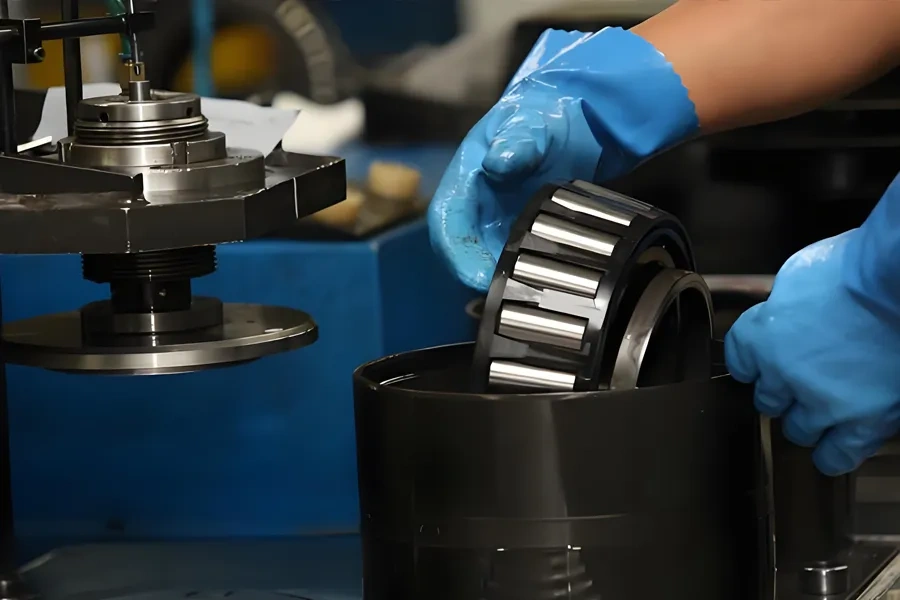
Preload methods are broadly categorised into radial preload and axial preload; a brief overview is provided below:
Radial preloading: Radial preloading is commonly used in tapered bore bearings subjected to radial loads. A typical example is the double-row precision short cylindrical roller bearing. By adjusting the axial position of this bearing relative to the tapered journal using a nut, the inner ring is expanded to the appropriate extent to achieve a negative radial clearance. This method is frequently employed in machine tool spindles and jet engines.
Axial Preload Method: The axial preload method can broadly be divided into two types: locating preload and constant pressure preload.
In positional preload, the appropriate preload can be achieved by adjusting the dimensions of the sleeve or shim; it can also be adjusted by measuring or controlling the starting friction torque; alternatively, preload can be achieved by directly using pairs of double-row bearings with pre-set preload, in which case the user generally does not need to make further adjustments. In short, for any bearing subjected to axial preload, its relative position will certainly not change during use.
Pressure preload is a method of applying suitable preload to bearings using coil springs, disc springs, and the like. The stiffness of the preload spring is generally much lower than that of the bearing; therefore, the relative position of bearings under pressure preload will change during use, although the preload amount remains largely constant.
A comparison of positional preload and constant-pressure preload is as follows:
(1) For the same preload value, positional preload has a greater effect on increasing bearing stiffness, and the impact of stiffness changes on bearing load is also much smaller.
(2) With positional preload, the preload value may change during operation due to factors such as axial length differences caused by temperature differences between the shaft and bearing housing, radial expansion caused by temperature differences between the inner and outer rings, and displacement caused by loads; whereas with constant-pressure preload, changes in preload during operation are negligible.
Bearing Torque, Load and Service Life
1. Starting torque: The torque required to initiate rotation of one bearing ring or washer relative to another fixed ring or washer.
2. Rotational torque: The torque required to prevent movement of one bearing ring or washer when the other is rotating.
3. Radial load: A load acting perpendicular to the bearing axis.
4. Axial load: A load acting in a direction parallel to the bearing axis.
5. Static load: A load acting on the bearing when the relative rotational speed of the bearing rings or washers is zero, or when the rolling elements are not moving in the direction of rolling.
6. Dynamic load: A load acting on the bearing when the bearing rings or washers rotate relative to one another, or when the rolling elements move in the direction of rolling.
7. Equivalent load: A general term used in load calculation theory; in specific circumstances, the bearing behaves as if it were subjected to the actual load under this theoretical load.
8. Radial Basic Static Load: The radial static load corresponding to the total permanent deformation of the rolling elements and raceways. If, under zero load, the rollers and raceways are, or are assumed to be, in their normal generatrix position, the total permanent deformation at the contact points between the rolling elements and raceways under maximum contact stress is 0.0001 times the diameter of the rolling element. For single-row angular contact bearings, the radial rated load is the radial component of the load that causes a purely radial relative displacement between the bearing rings.
9. Radial basic rated dynamic load: a constant radial load under which the rolling bearing can theoretically withstand a basic rated life of 1 million revolutions. For single-row angular contact bearings, this radial rated load is the component of the load that causes purely radial relative displacement between the bearing rings.
10. Life: The number of revolutions of one ring or one washer relative to another ring or washer before the first appearance of fatigue cracking in the material of one ring, one washer or one rolling element. Life may also be expressed in terms of operating hours at a given constant speed.
11. Reliability: The percentage of bearings in a group of nearly identical rolling bearings operating under the same conditions that are expected to reach or exceed a specified life. The reliability of a set of bearings is the probability that the set will reach or exceed the specified life.
12. Rated life: A predicted value of life based on the basic dynamic radial load rating or the basic dynamic axial load rating.
13. Basic rated life: The rated life associated with 90% reliability.
14. Life factor: A correction factor applied to the equivalent dynamic load to obtain the basic rated radial dynamic load or basic rated axial dynamic load corresponding to a given rated life.
15. Mounted bearing: An assembly comprising a radial bearing and a housing, featuring a base plate with mounting screws on a support surface parallel to the bearing axis.



You can select product type online samples, product samples, installation manuals, and OID Product related applications here.
You can find here that in addition to various bearings, we also provide various products such as automotive parts and precision machinery products to the world.