
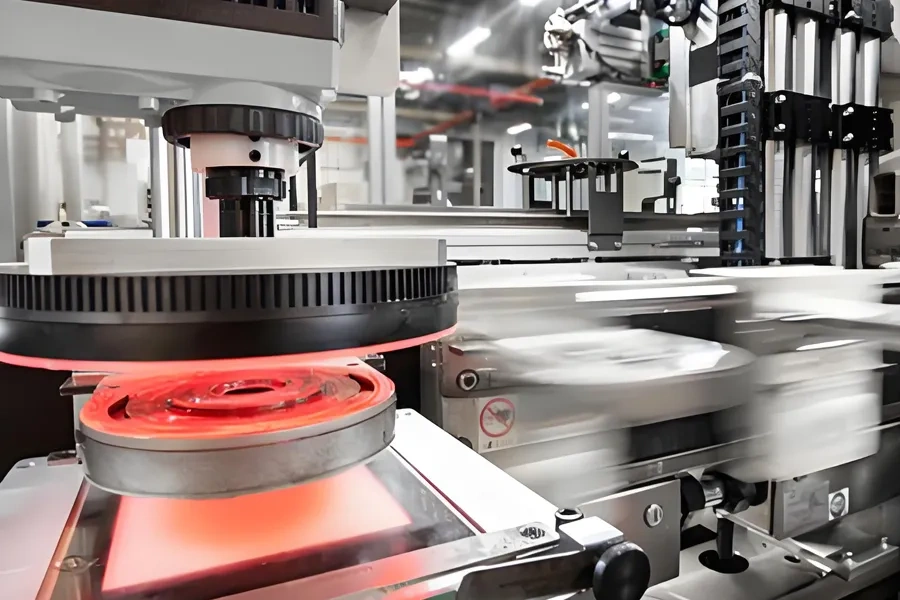
The sound of rolling bodies; this noise generally occurs in large bearings operating at low speeds and under radial loads. When a bearing operates under a radial load, the bearing is divided into loaded and unloaded zones. If the bearing has a certain amount of radial clearance, the rolling elements in the unloaded zone do not contact the inner raceway; however, due to centrifugal force, they may come into contact with the outer ring. At low speeds, when the centrifugal force is less than the weight of the rolling elements, the rolling elements will fall and collide with the inner raceway or the cage, thereby exciting the bearing’s natural vibrations and generating noise.
It also exhibits the following characteristics: it is prone to occur when only radial loads are applied and the radial clearance is large. It may also occur within a specific range, and the speed range varies for bearings of different sizes. It is more likely to occur with grease lubrication than with oil lubrication. It is even more likely to occur when inferior grease is used. The noise may be continuous or intermittent. It frequently occurs in winter.
This forced vibration often excites the second- and third-order bending natural vibrations of the outer ring, thereby generating the noise. This noise can be effectively reduced by applying preload to decrease the bearing’s radial clearance after installation; the use of high-quality lubricants can also help. Some overseas manufacturers employ technical measures such as lightweight rolling elements—for example, ceramic or hollow rollers—to prevent this noise from occurring. Rolling element pass-through vibration: When a bearing operates under radial load, only a few rolling elements bear the load internally. The spring-like support formed by the elastic contact with the rings causes the rolling elements to undergo periodic vibration as they pass through the line of action of the radial load. Consequently, the shaft centre moves vertically up and down or horizontally, thereby generating noise. This type of vibration is known as rolling element pass-through vibration, and is particularly pronounced during low-speed operation. Its amplitude is related to the bearing type, radial load, radial clearance and the number of rolling elements. Typically, this amplitude is small; it only becomes problematic when the amplitude is large. Consequently, measures such as reducing the radial clearance or applying an appropriate preload are often employed to mitigate it. A screeching noise is a rather intense shriek caused by sliding friction between metal surfaces. Although the bearing temperature does not rise significantly in this case, and it has little effect on bearing life or grease life, nor does it affect rotation, the unpleasant sound is unsettling. This noise is particularly common in large, short cylindrical roller bearings subjected to radial loads.
Cage noise is produced by the free vibration of the cage during bearing rotation, as well as by its impact with the rolling elements or rings. It can occur in all types of bearings, but the sound pressure level is not particularly high and the frequency is low. A characteristic feature is that it occurs regardless of whether the bearing is lubricated with oil or grease. Both stamped and plastic cages can produce this noise. It is more likely to occur when the radial clearance is large. It is most likely to occur when the outer ring is subjected to a bending moment.
As gaps between the cage pockets and between the cage and the rings are unavoidable in finished bearings, it is very difficult to eliminate cage noise completely; however, it can be improved by reducing assembly errors and optimising the clearance and cage displacement. Another type of characteristic cage noise is a humming sound caused by self-excited vibration of the cage resulting from friction between the cage and the guide surfaces of other bearing components. The stamped cages of deep groove ball bearings are relatively thin, with low bending stiffness in both the radial and axial planes and poor overall stability. When the bearing rotates at high speeds, self-excited vibration occurs due to bending deformation, resulting in a humming sound.
When the bearing is subjected to radial loads and the grease performance is poor, a clicking or clacking noise may be heard during the initial running-in period. This is primarily caused by the rolling elements suddenly accelerating after leaving the load zone and colliding with the cage. Although this impact noise is unavoidable, it will disappear after the bearing has been in operation for a period of time. Measures to prevent cage noise are as follows: when the bearing rotates at high speed, the vibration amplitude of a cage with a large pocket clearance is significantly greater than that of a cage with a small pocket clearance; therefore, the selection of the pocket clearance is particularly important. To ensure stable circumferential movement of the cage, ring-guided designs should be used wherever possible, and care must be taken to ensure adequate lubrication of the guide surfaces. For tapered roller bearings operating at high speeds, the design should be modified by replacing L-type cages (guided by the rollers) with Z-type cages (guided by the ring flanges).
Care should be taken to minimise radial clearance as much as possible. Improving the manufacturing precision of the cage and enhancing its surface quality helps to reduce noise caused by collisions or friction between the rolling elements and the cage. Advanced cleaning technologies should be actively adopted to ensure effective and thorough cleaning of components and assembled products, thereby improving the cleanliness of the bearings.
You can select product type online samples, product samples, installation manuals, and OID Product related applications here.
You can find here that in addition to various bearings, we also provide various products such as automotive parts and precision machinery products to the world.